



Cookies help us deliver our services. By using our services, you agree to our use of cookies.
What is astigmatism?
Astigmatism: A Comprehensive Guide
Understanding the vision defect that blurs contours and details
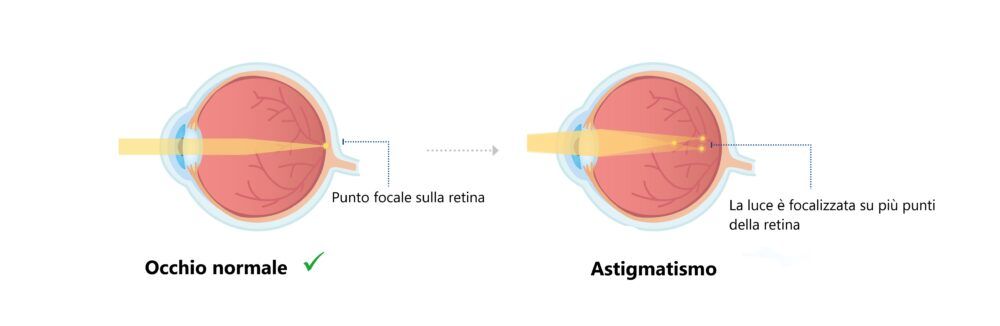
Astigmatism is a common vision condition (ametropia) that causes blurred or distorted vision. This happens because the surface of the eye (cornea) or the lens inside the eye has an irregular shape. In an astigmatic eye, images are not focused clearly on the retina, causing objects to appear blurry at all distances.
It is very common and often occurs alongside other vision problems like nearsightedness (myopia) or farsightedness (hyperopia).
Types of Astigmatism
Depending on which part of the eye causes the distortion, we distinguish between:
- Corneal astigmatism: caused by an irregular curvature of the cornea.
- Lenticular astigmatism: caused by an irregular shape of the lens inside the eye.
Classification based on meridians:
- With-the-rule: the most common form, where the vertical meridian is the steepest.
- Against-the-rule: where the horizontal meridian is the steepest.
- Oblique: where the steepest curve is at a diagonal angle.
Symptoms: How to recognize it?
Uncorrected astigmatism forces the eye to constantly work to find focus (accommodation). Frequent symptoms include:
- Blurred or distorted vision at any distance.
- Poor peripheral (side) vision.
- Difficulty distinguishing shapes and fine details.
- Inability to see straight lines clearly (vertical or horizontal).
.jpeg)
Note: If left untreated, it can cause frequent headaches, eye strain (especially after using a computer), and chronic fatigue during reading.
Causes and How It Works
Why does it happen? In a perfect eye (emmetropic), the cornea is round like a basketball. In an astigmatic eye, the cornea is shaped more like a football or a rugby ball.
This irregular shape prevents light from focusing on a single point on the retina, scattering it across multiple points and creating a "blur" effect. While often present from birth, it can also be caused by:
- Corneal scarring from infections.
- Post-eye surgery complications.
- Specific conditions such as Keratoconus.
Diagnosis and Testing
Regular eye exams are essential, especially for children, to prevent conditions like "lazy eye" (amblyopia). Key tests include:
- Visual Acuity Test: reading letters on a Snellen chart.
- Keratometry: measuring the curvature of the cornea using a keratometer.
- Corneal Topography: a 3D computerized mapping of the cornea, vital for complex cases.
Correction and Treatment
Today, astigmatism can be effectively corrected in several ways:
1. Corrective Lenses
Glasses with cylindrical or toric lenses and contact lenses are the most common solutions. They compensate for corneal irregularity, allowing light to focus correctly on the retina.
2. Refractive Laser Surgery
Techniques like LASIK or PRK can reshape the cornea. While effective, it requires a thorough medical evaluation to determine candidacy.
