



Cookies help us deliver our services. By using our services, you agree to our use of cookies.
What is Hyperopia?
What is Hyperopia?
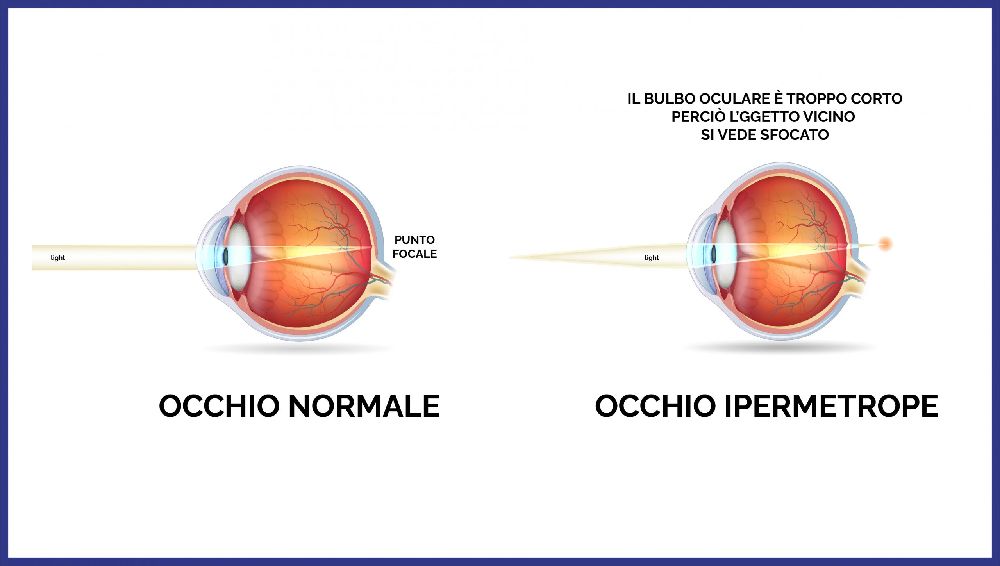
Hyperopia, commonly known as farsightedness, is a vision defect (ametropia) that often presents no obvious symptoms in the early stages but can cause significant visual fatigue. In a farsighted eye, light rays do not focus on the retina, but rather "behind" it.
This phenomenon is primarily due to an eyeball that is shorter than normal (axial hyperopia) or a cornea that is excessively flat.
Symptoms: How to Recognize It
In Adults
Adults often compensate for hyperopia through accommodation, but as they age (especially after 40), this effort becomes more difficult, leading to:
- Blurred vision of nearby objects
- Fatigue after reading or computer work
- Frontal headaches
- Eye burning or aching
- A tendency to squint
In Children
Children have very flexible eyes that can mask the defect. However, if severe and left uncorrected, hyperopia can cause:
Watch for the signs: If your child frequently rubs their eyes, has red eyes, excessive tearing, or difficulty reading, an eye exam is essential to prevent lazy eye (amblyopia) or strabismus.
Causes and Eye Anatomy
Correct eye function depends on four main components working in harmony:
- Cornea and Lens: The front "lenses" that focus light.
- Retina: The light-sensitive tissue at the back that receives images.
- Optic Nerve: The "cable" that sends signals to the brain.
In hyperopia, if the cornea is too flat or the lens is too thin, light falls behind the retina, making near objects appear blurry.
Solutions and Compensation
Today, hyperopia can be successfully managed through various options depending on your lifestyle and the severity of the defect:
Corrective Glasses
Glasses use convex lenses (thinner at the edges, thicker in the center) to bring the focus exactly back to the retina. This is the simplest and safest solution.
Contact Lenses
Contacts offer a wider field of vision and are ideal for active individuals. However, they require strict hygiene to avoid eye infections.
Refractive Laser Surgery
Procedures such as PRK, Lasek, or Lasik allow the cornea's curvature to be reshaped, eliminating or drastically reducing the need for glasses.
